
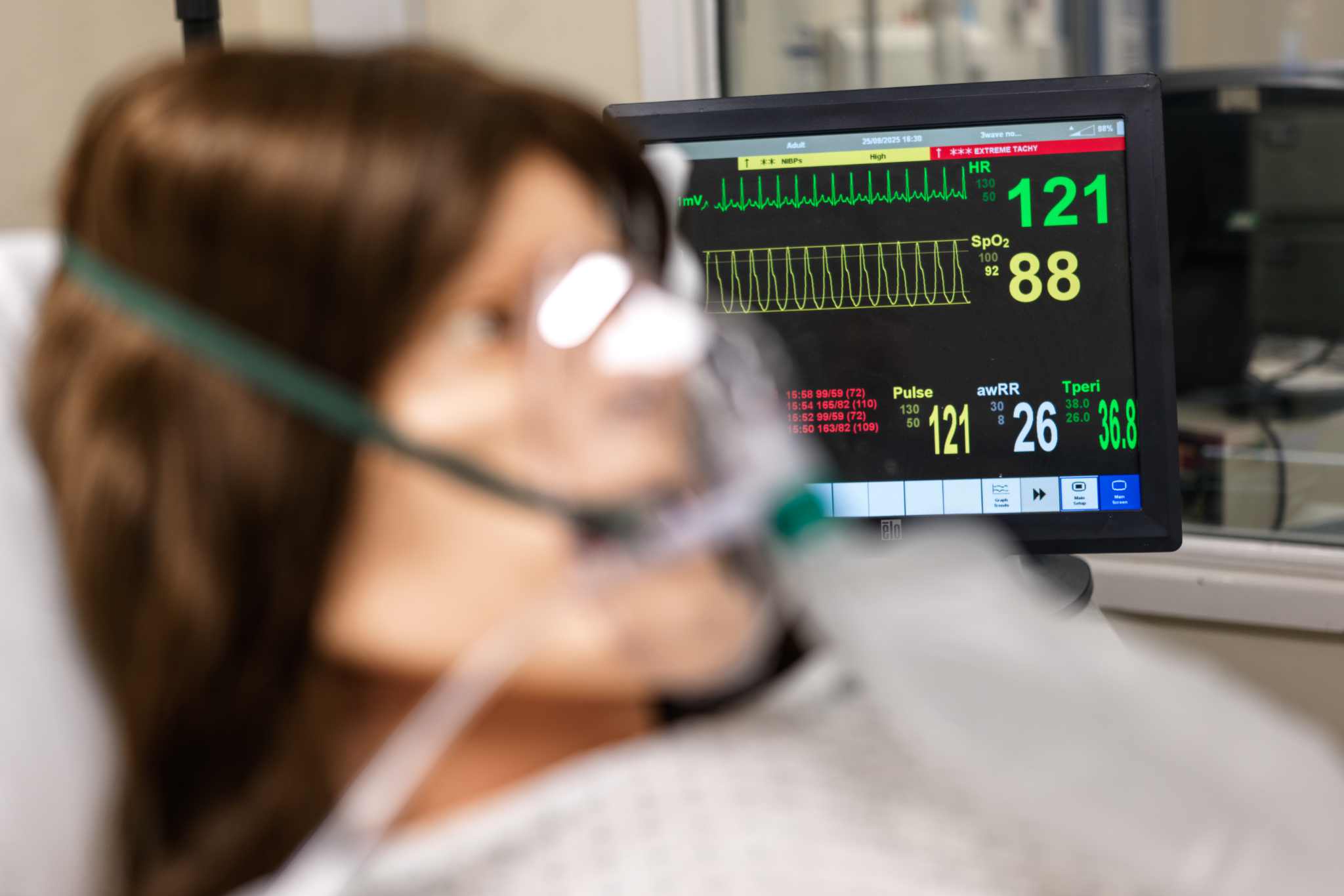
Brenda
A-to-E Assessments Simulation
Use this resource in conjunction with your real-world training

Experience Summary
In this 360° experience, watch an A to E assessment on a 68-year-old patient named Brenda.
Please note that these A to E assessments are intended for reflection and discussion. They are not perfect patient assessments, and investigation and management of these patients may change according to your local guidelines.
Case background
68-year-old female: Brenda
PC: 4-day history of cough and SOB.
HPC: Non-productive cough for last 4 days. Becoming progressively SOB over last 2 days, and now struggling to breathe. Associated right sided pleuritic chest pain mostly on coughing. Today, husband is concerned as Brenda seemed confused.
No rashes, no headache, no abdominal pain and no urinary symptoms.
PMH: Hypertension. Hyperlipidaemia. Osteoarthritis
DH: Lisinopril. Simvastatin. Paracetamol. NKDA
SH: Retired teacher. Ex-smoker. Independent. Lives with husband
Community acquired pneumonia
Community-acquired pneumonia (CAP) is an acute infection of the lung parenchyma acquired outside hospital settings. It commonly results from bacterial pathogens such as Streptococcus pneumoniae, Haemophilus influenzae, and atypical organisms like Mycoplasma pneumoniae. Viral causes, including influenza and respiratory syncytial virus, are also significant, particularly in seasonal outbreaks. Patients typically present with cough, fever, dyspnoea, pleuritic chest pain, and sputum production. Older adults may show atypical features such as confusion, reduced appetite, or functional decline. Diagnosis is supported by clinical examination, vital signs, chest auscultation, and confirmatory chest radiography.
Initial assessment focuses on severity evaluation using tools such as CURB-65 to guide decisions about community versus hospital management. Mild cases may be treated in primary care with empirical antibiotics, commonly amoxicillin or doxycycline in penicillin-allergic individuals. Patients with moderate or severe pneumonia, significant comorbidities, hypoxia, or sepsis require hospital admission for intravenous antibiotics, oxygen therapy, and monitoring. Microbiological testing, including blood cultures and sputum samples, is usually reserved for more severe presentations.
Supportive care—hydration, analgesia, antipyretics, and smoking cessation advice—is essential. Follow-up is needed to ensure clinical resolution, with repeat imaging considered in patients with persistent symptoms or risk factors for underlying malignancy.
Discussion points
- What was good about the clinicians A to E assessment?
- What could the clinician improve about their A to E assessment?
- How was the clinician’s communication throughout the A to E assessment?
- How did the clinician make the decision to treat the patient as community acquired pneumonia?
- What is your local management for community acquired pneumonia?
- What would be the next steps in the investigation and management of this patient?
Learning Outcomes
- Observe an ABCDE assessment for a critically unwell patient.
- Increase understanding of arterial blood gas interpretation.
- Increase understanding of the types of respiratory failure.
- Increase understanding of the CURB-65 score.
- Increase understanding of the management of sepsis.
External Resources
- Pneumonia: diagnosis and management ****- NICE guideline
- ABG Interpretation - Geeky Medics