
Malignant Hyperthermia
Anaesthetic Critical Incidents Simulation
Use this resource in conjunction with your real-world training

Experience Summary
In this experience, observe the management of an intubated patient with malignant hyperthermia.
Clinical Context
Malignant hyperthermia (MH) is a rare, life-threatening pharmacogenetic disorder of skeletal muscle metabolism, typically triggered by volatile anaesthetic agents or depolarising neuromuscular blockers such as suxamethonium. It is most commonly associated with mutations in the ryanodine receptor (RYR1), leading to uncontrolled calcium release from the sarcoplasmic reticulum. This results in a hypermetabolic state characterised by increased oxygen consumption, carbon dioxide production, heat generation, and muscle rigidity.
Signs of Malignant Hyperthermia
In an intubated patient under general anaesthesia, MH often presents with a rapid rise in end-tidal CO₂ despite increased minute ventilation, unexplained tachycardia, muscle rigidity (especially masseter spasm), and metabolic and respiratory acidosis. Hyperthermia is a late sign. Other features include hyperkalaemia, arrhythmias, myoglobinuria, and rising creatine kinase.
Management of Malignant Hyperthermia
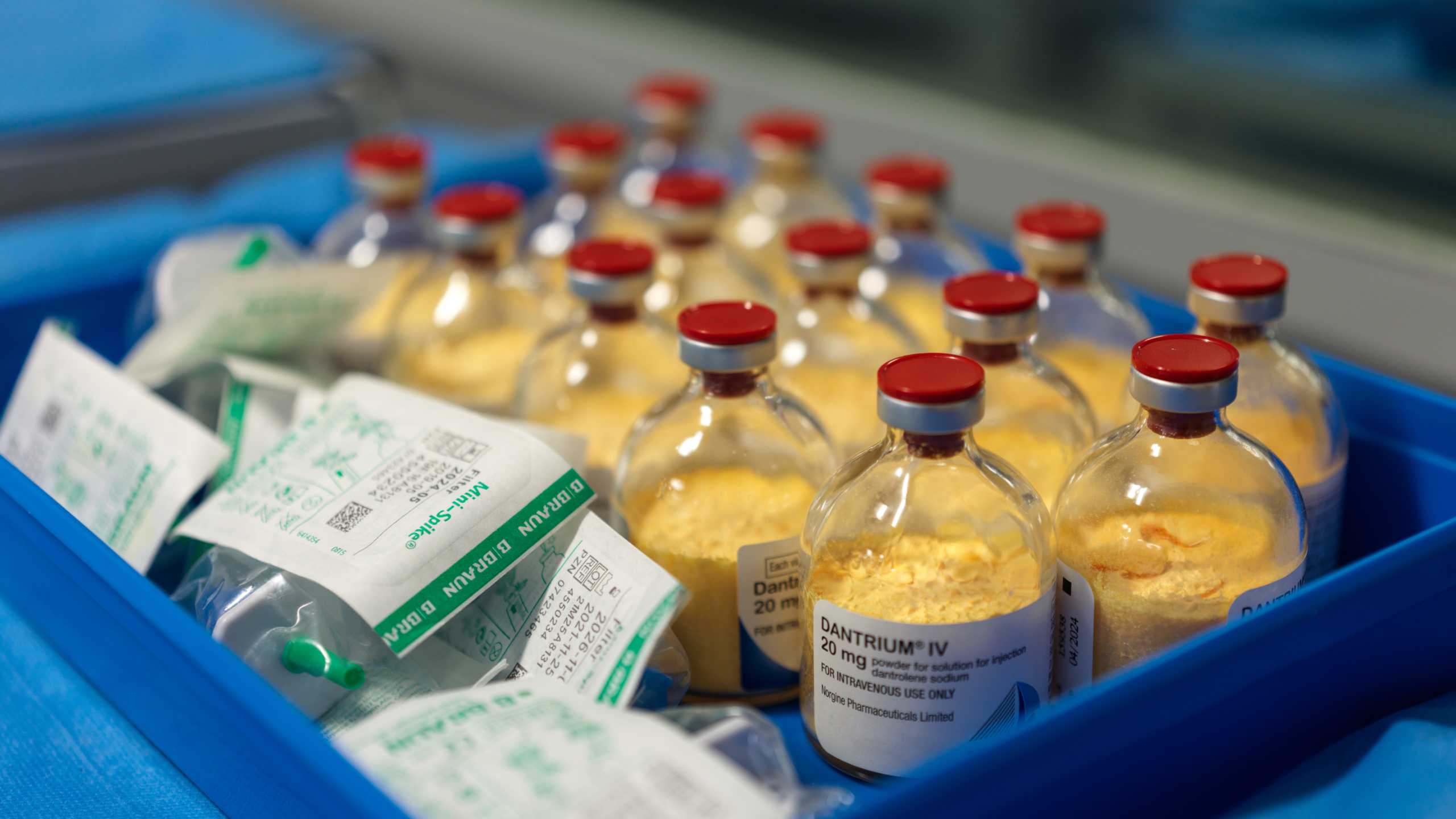
Management requires immediate recognition and decisive action. The first step is to stop all triggering agents and call for help, activating the MH protocol. Anaesthesia should be maintained using non-triggering agents such as intravenous propofol, and the anaesthetic machine should be flushed with high fresh gas flows or a dedicated “clean” machine used if available. The cornerstone of treatment is prompt administration of Dantrolene, given as an initial dose of 2.5 mg/kg intravenously and repeated as necessary until clinical improvement is observed. Dantrolene acts by inhibiting calcium release from the sarcoplasmic reticulum, thereby reversing the hypermetabolic state. Supportive management is critical. The patient should be hyperventilated with 100% oxygen to treat hypercapnia and metabolic acidosis. Active cooling measures, including cold intravenous fluids, ice packs, and cooling blankets, should be initiated if the temperature is significantly elevated. Care must be taken to avoid overcooling. Metabolic abnormalities must be corrected. Hyperkalaemia should be treated promptly with calcium chloride or gluconate, insulin and glucose, and possibly sodium bicarbonate. Arrhythmias should be managed according to standard protocols, avoiding calcium channel blockers in combination with dantrolene due to the risk of hyperkalaemia and cardiovascular collapse. Continuous monitoring is essential, including arterial blood gases, electrolytes, core temperature, urine output, and coagulation profile. An arterial line is usually required. Myoglobinuria should be managed with aggressive fluid resuscitation to maintain renal perfusion, and consideration of urinary alkalinisation. Following stabilisation, the patient requires admission to critical care for ongoing monitoring, as recrudescence can occur within 24–48 hours. Dantrolene maintenance dosing may be required. Documentation and referral for definitive testing, such as the caffeine-halothane contracture test, are important, along with counselling of the patient and family regarding future anaesthetic risks.
Learning Outcomes
- Observe the multidisciplinary approach to a patient with malignant hyperthermia.
- Understand the signs and symptoms of malignant hyperthermia isn an intubated patient.
- Understand the key management principles of malignant hyperthermia.
External Resources