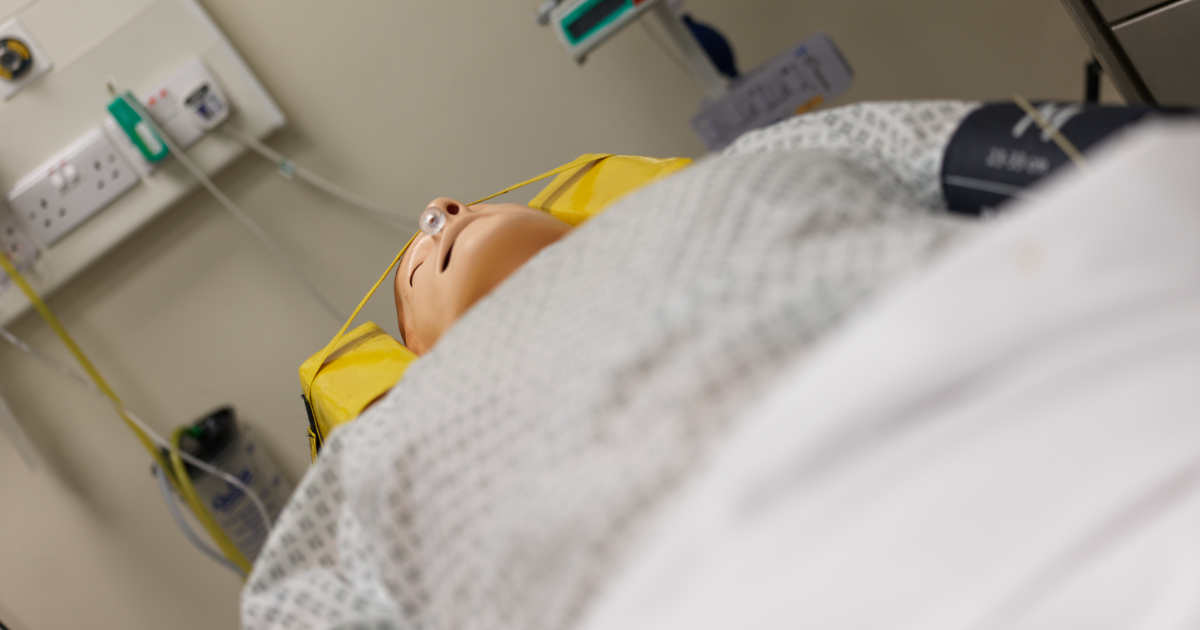
Maurice
A-to-E Assessments Simulation
Use this resource in conjunction with your real-world training

Experience Summary
In this 360° experience, watch an A to E assessment on a 62-year-old patient named Maurice.
Please note that these A to E assessments are intended for reflection and discussion. They are not perfect patient assessments, and investigation and management of these patients may change according to your local guidelines.
‘Walton’ refers to the local tertiary neurosurgical unit, and ‘Orion’ is the system that referrals to neurosurgery are made through.
Case background
62-year-old male: Maurice
PC: Head injury
HPC: Slipped on wet surface at home and sustained head injury. LoC for few minutes. Confused and drowsy since. Fall witnessed by wife.
PMH: Hypertension. Hyperlipidaemia. IHD. AF
DH: Atorvastatin. Bisoprolol. Apixaban. GTN spray. NKDA
FH: Father died of colon cancer – aged 56 years. Mother had hyperthyroidism
SH: Civil servant. Ex-smoker. Independent. Lives with wife
Intracranial bleeds
Intracranial bleeds (ICBs) encompass a group of acute neurological emergencies caused by bleeding within the skull. The major types include intracerebral haemorrhage (ICH), subarachnoid haemorrhage (SAH), subdural haematoma, and epidural haematoma. They may arise spontaneously—most commonly from hypertension, cerebral amyloid angiopathy, or ruptured aneurysms—or follow trauma, anticoagulation, or vascular abnormalities. Patients typically present with sudden-onset neurological deficits, reduced consciousness, severe headache, vomiting, seizures, or signs of raised intracranial pressure. In traumatic cases, symptoms can evolve rapidly or follow a lucid interval, particularly in epidural haematomas.
Diagnosis relies on urgent non-contrast CT head imaging, which rapidly identifies the location and extent of bleeding. CT angiography may be required to detect aneurysms or vascular malformations. Initial management focuses on stabilisation: securing the airway, correcting hypotension or hypertension, controlling seizures, and reversing anticoagulation where appropriate. Neurosurgical input is essential, as some bleeds—such as large subdural or epidural haematomas—may require urgent surgical evacuation. In ICH, blood pressure control, intracranial pressure management, and neurocritical care support are central. SAH typically requires early aneurysm repair via clipping or coiling and meticulous prevention of vasospasm.
Ongoing care includes neurological monitoring, prevention of complications, and rehabilitation to optimise functional recovery.
Discussion points
- What was good about the clinicians A to E assessment?
- What could the clinician improve about their A to E assessment?
- How was the clinician’s communication throughout the A to E assessment?
- What do you think of the clinician’s assessment of the patient’s GCS?
- How should this patient’s anticoagulation be reversed?
Learning Outcomes
- Observe an ABCDE assessment for a critically unwell patient.
- Increase understanding of GCS assessment.
- Increase understanding of airway management.
- Increase understanding of NICE head injury guidelines.
- Increase understanding of anticoagulant reversal.
External Resources
- Major trauma: assessment and initial management - NICE guideline
- Head injury: assessment and early management - NICE guideline