
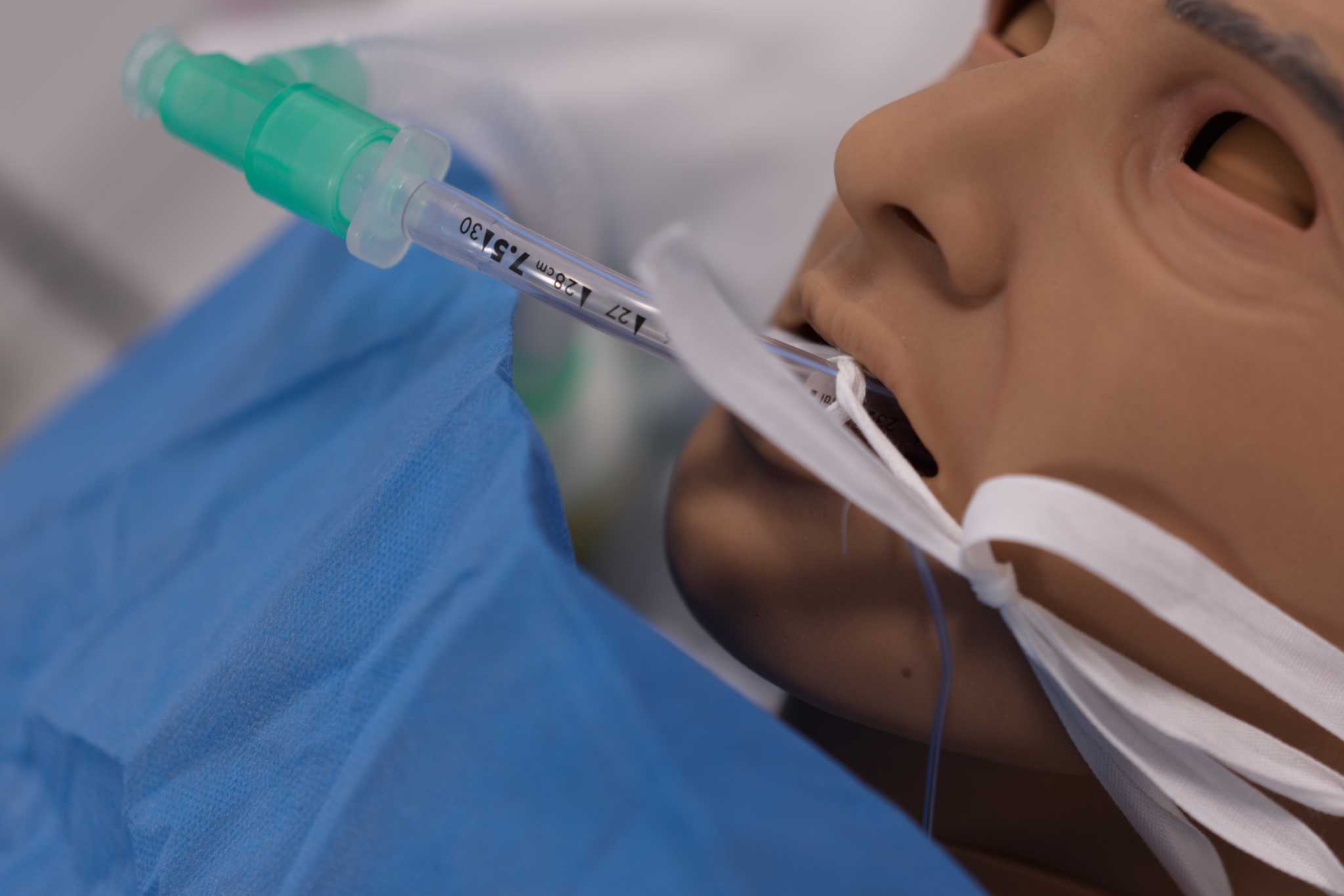
Laryngospasm
Anaesthetic Critical Incidents Simulation
Use this resource in conjunction with your real-world training

Experience Summary
In this experience, observe the management of a patient with an i-gel in situ who enters laryngospasm.
Clinical Context
Laryngospasm is a reflex closure of the vocal cords due to stimulation of the superior laryngeal nerve, resulting in partial or complete airway obstruction. It most commonly occurs during light anaesthesia, particularly at induction or emergence, and is a recognised complication in patients managed with supraglottic airway devices such as an i-gel, where the airway is not definitively secured.
Signs of Laryngospasm
In a patient with an i-gel in situ, laryngospasm may present as difficulty or inability to ventilate despite a seemingly well-positioned device. Clinically, there may be high airway pressures, reduced or absent tidal volumes, and a loss or reduction of the capnography waveform. Oxygen saturation may fall rapidly. If the patient is breathing spontaneously, paradoxical chest and abdominal movements (“rocking horse” respiration) may be observed. Stridor may be audible in partial obstruction. It is important to differentiate laryngospasm from other causes of poor ventilation such as device malposition, obstruction (e.g. secretions), or bronchospasm.
Management of Laryngospasm
Management requires immediate and coordinated action. The first step is to call for help and administer 100% oxygen. Any precipitating stimulus, such as airway manipulation or surgical stimulation, should be stopped. The anaesthetist should ensure optimal positioning of the airway, including head tilt and jaw thrust, which may help relieve partial obstruction. Deepening anaesthesia is a key early intervention. This is commonly achieved with a bolus of intravenous propofol, which suppresses airway reflexes and may break the spasm. Continuous positive airway pressure (CPAP) with 100% oxygen should be applied via the breathing circuit. Gentle but firm positive pressure ventilation may help overcome partial laryngospasm, although excessive force should be avoided to reduce the risk of gastric insufflation. If the spasm persists or becomes complete, more definitive management is required. Removal of the i-gel may be necessary, particularly if it is contributing to airway stimulation or ineffective ventilation. A rapid-acting neuromuscular blocker such as Suxamethonium should be administered, typically intravenously (0.5–1 mg/kg), to achieve prompt relaxation of the vocal cords. Once paralysis is achieved, the airway should be secured, usually with endotracheal intubation, and ventilation re-established. Following resolution, the patient should be closely monitored for complications such as hypoxia, aspiration, or negative pressure pulmonary oedema. Preventative strategies include ensuring adequate depth of anaesthesia during airway manipulation, minimising airway irritation, and careful planning of emergence.
Learning Outcomes
- Observe the management of laryngospasm with a patient with an i-gel in situ.
- Understand the signs of laryngospasm in a patient with an i-gel in situ.
- Understand the management and onward care required for a patient with laryngospasm.
External Resources